.jpg)
In the current product development environment, we have moved from referring to the “technological processes” to “product lifecycles” which tends to describe specific technological processes a little more clearly.
Product development lifecycles describe what happens and when, during the development of a product.
All products have some sort of lifecycle that can be described in more or less detail.
A simple loaf of bread has a cycle – bake the bread, deliver the bread, eat the bread, dispose of the leftovers.
This can be more detailed, and we can describe the whole process of baking the bread in great detail – mix flour, water, yeast, sugar, oil in specific proportions, allow to rise for 30 minutes, knock back, place in baking tins, allow to rise for 30 minutes, bake at 180°C for 45 minutes, turn out and allow to cool.
We can have even more detail and describe the process of milling the flour etc.
In our current environment, we have essentially two lifecycle types that interest us the most: hardware development lifecycles and software development lifecycles.
Generally, a product life cycle is the normal process of ideas becoming reality until the product is obsolete and destroyed. There are some specific phases which are common to most product lifecycles:
The general product development life cycle is:
The idea phase of the product life cycle is the step in which someone has the idea for a product. This is the first general concept of the product
Requirements management is when the particulars of the design are determined. For example, the idea of a new vehicle becomes a set of technical specifications at this stage
Development is the merge of the initial design with the defined requirements, the creation of a prototype and working models. The development phase is when you build a prototype and improve its manufacturability.
Production occurs when the product is mass-produced. Operation and maintenance is when the product is being used. Operations are literally performed by operators or users of the product
Maintenance may be done by the manufacturer or customers themselves. For example, operations may be the installation and repairs of air conditioners while customers perform maintenance like changing its air filters
Disposal is the final phase. Ideally, products are recycled or re-manufactured. However, disposal in a landfill or incinerator is typical.
There are many international standards that relate to the product development lifecycle:
ISO/IEC 12207; ISO Systems and Software Life Cycle Processes Standard
ISO/IEC 15288; ISO Standard for System Life Cycle Processes
Software and Hardware follow the general product lifecycle, differing from each other and other types of products at the development phase.
The Software Development Life Cycle or SDLC is broken down into five steps.
They are:
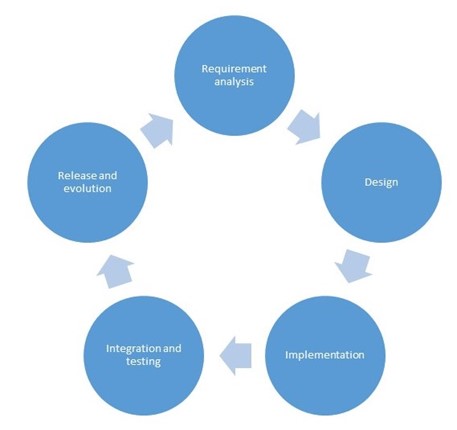
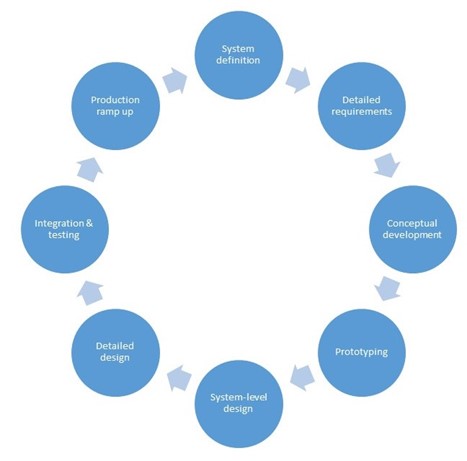
The Hardware Development Life Cycle or HDLC is broken down into eight steps.
They are:
These cycles are not rigid and different development environments may add or remove elements to improve their processes.
Hardware is physical, therefore additional steps to determine the design of each individual part are required. It may occur that parts must be manufactured to be mechanically attached to each other. This may require a few iterations in the design, manufacture and test cycles.
Similarly, the parts may be required to communicate with each other so various interfaces may need to be designed. Thereafter the product is tested and refined.
The primary difference between hardware and software development life cycles is the testing of not only individual components but of the final assembly as well.
Since software code is easily altered and recompiled during testing, most of the software changes will take place in the integration and test phase. All of the testing for the program is done for the software product as a whole, although you can test software modules separately from the whole program.
Many changes will occur during testing and refinement for hardware, but the design will only change in the production ramp-up stage if necessary for the product to work or be manufactured at a reasonable cost.